Green Chapel
Sir Gawain and the Green KnightThe Green Chapel is the remote destination named in the Green Knight’s challenge to Sir Gawain, and the point toward which the poem’s journey of obligation is directed. Its importance lies not in a clearly described building but in the promise attached to it: Sir Gawain must find the Green Knight there and receive, on New Year’s morning, the blow he dealt. When the knight finally reaches the place, its appearance is difficult to identify, giving the meeting ground an unsettling uncertainty that contrasts with the formal court where the agreement began.
The Appointed Place
The Green Chapel enters the story as the required location for completing the challenge. In the hall, before the assembled knights, the Green Knight orders Sir Gawain to seek him there and take the return stroke on New Year’s morning. The appointment makes the place more than a destination. It gives the earlier exchange a deadline and a geography: Sir Gawain must not merely remember his promise but travel to the place where it can be tested.
The terms make failure a matter of reputation as well as danger. The Green Knight says that he is known as the knight of the Green Chapel and insists that Sir Gawain will not fail to find him if he makes the attempt. He frames refusal as grounds for being called recreant. The chapel thus stands at the end of a path set by public speech: the promise was made in the hall before witnesses, while its fulfilment is postponed to a distant encounter.
The poem also presents the adventure as one of King Arthur’s marvels, and later recalls the episode as an adventure sought by the young king. Within that frame, the Green Chapel marks the movement from courtly spectacle into a dangerous test beyond the court. The location’s force comes partly from this change of setting: a spoken game at court acquires consequences through travel, delay, and the prospect of bodily harm.
The Approach and the Deadline
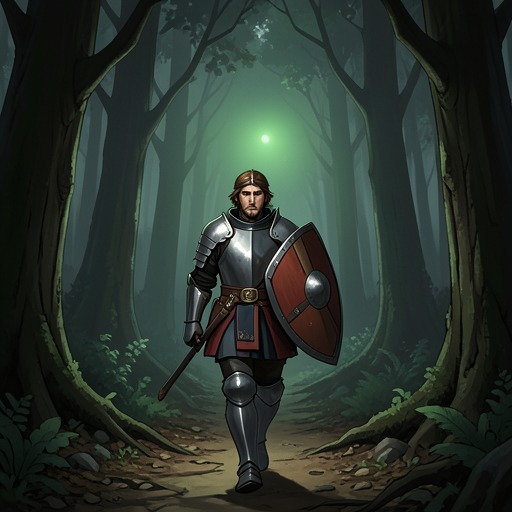
Sir Gawain’s route toward the appointed place passes over a mountain and into a deep forest, with high hills on either side and woodland below. These details establish a landscape unlike the ordered hall in which the challenge was issued, but they do not provide a precise map or a settled architectural description of the chapel itself. The journey gives the appointment a physical cost while leaving its final destination obscure.
Near the end of his stay with his host, Sir Gawain says that only three days remain and that he would rather face death than fail his errand. The host laughs and promises to guide him to the destination when the time comes, assuring him that the Green Chapel need trouble him no longer. That reassurance turns the location into a subject of conversation before Sir Gawain reaches it: the host treats it as a known place, while for the traveller it remains the site of an approaching reckoning.
The calendar matters as much as the terrain. The Green Knight’s instruction fixes the return blow for New Year’s morning, so the journey is governed by a date that has been approaching since the agreement at court. The chapel gathers this temporal pressure into one point. Sir Gawain arrives not as a casual visitor but as a man who has measured the remaining days against the obligation he accepted.
An Uncertain Form
At the destination, Sir Gawain cannot confidently decide what he is seeing. He wonders whether the Green Chapel might instead be a crevice in an old crag. The description leaves open whether the place is a chapel in the familiar architectural sense or a formation in the rock; the evidence offered here does not settle the question. That uncertainty matters because the name promises a recognizable sacred building, while the sight before Sir Gawain resists easy classification.
The contrast sharpens the scene without requiring the chapel to be fully explained. The Green Knight’s instructions have made it sound like a known destination, but Sir Gawain’s first response is a question about what kind of place stands before him. The setting is at once named in advance and strange on arrival. Its obscurity concentrates attention on the approaching encounter rather than on any established history, community, or built design.
Meeting and Revelation
Sir Gawain calls out at the place, asking who will answer him there and announcing that he has come. The Green Knight responds by welcoming him and saying that he has timed his journey as a true man should. The greeting confirms that Sir Gawain has reached the appointed destination and arrived within the terms of the challenge. It also shifts the scene from solitary uncertainty to direct recognition: the place that was known to one party and unknown to the other becomes their meeting ground.
At the final encounter, the Green Knight identifies himself as the lord of Hautdesert and reveals that his power comes through Morgan le Fay, who lives in his house. This disclosure recontextualizes the figure and the challenge connected with the Green Chapel. The place has served as the destination of an apparently straightforward appointment, but the encounter there exposes a larger design behind the Green Knight’s role. The chapel’s narrative significance therefore depends on both sides of the meeting: it is where Sir Gawain comes to answer his promise and where the identity behind that promise is made clearer.
The Green Chapel’s defining feature is this combination of fixed obligation and uncertain appearance. It can be named, sought, and reached on a stated morning, yet Sir Gawain initially cannot tell whether it is a chapel or a cleft in rock. The poem uses that tension to make the destination feel less like a settled landmark than the threshold of the test: the promise is precise, but the place in which it must be faced remains strange.